

Students in my class have a “work plan” that they receive each week. It’s a sort of “task list meets lesson
plan” that is slightly different for each student (or in certain instances, dramatically different).
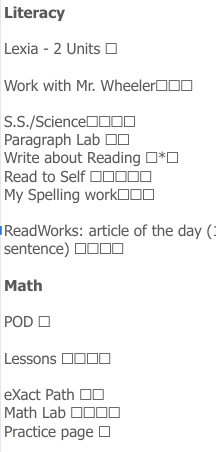
One of the work routines in my classroom looks like this: a short lesson on reading/writing is followed by a small group meeting with the teacher while students work on independent work. After 2-3 rotations of this, I call us together and we reflect and share on our work time. Some students volunteer and others are called on to answer the questions “What went well? And what could have gone better?”
“Ok, students. Nice job, I could tell we were very busy and many of us were very focused. Let’s reflect and share. What went well for you? Yes…J…”
J: “I got my paragraph assignment done and had time to read my book afterward.”
Teacher and classmates: “That’s awesome, me too, good job!”
Me: “What else?…yes, K…what went well?”
“I forgot how to get to the spelling words, but L helped me and I got my practice done.”
More congratulations and echoes follow.
Me: “What challenges did we have? What could have gone better?”
M: “I got stuck on assignment x. I couldn’t figure it out. I tried to just think real hard and asked my neighbor for help but she was busy.”
Me: “Oof. That sounds frustrating. What could you have done instead when you got stuck?”
M: “I should have just moved on to something else.”
P: “I got distracted and, to be honest, I was kind of goofing around.”
Me: “What could you have done differently?”
P, with a shrug: “I don’t know.”
Me: “Well, for this next part, why don’t you start working at your desk.”
OR Me: “We can talk about it at group. In fact, let’s have your group come over to the table as we
This rhythm creates a great time to celebrate student success. It also creates an accountability structure where it’s safe to publicly say “I did not get my independent work done because I chose to be distracted, got stuck, forgot how to do something.” This happens with regularity; most 8 year olds are capable of remarkable honesty. It also acknowledges a universal human experience: I’m not always at my best.
On the best days and for most students, this rhythm and routine creates a positive feedback loop. It’s safe to fail, but accountability is inescapable. We can cut through the garbage, get to the point, and make a plan for future success. This means that next time, I’m motivated, accountable and ready to get to the work of practicing, learning, and growing. I’ve found that for the majority of students, they take the responsibility seriously and encourage each other toward success.
In the microcosm of my classroom, this routine creates one of many feedback loops. Is it a positive feedback loop for everyone? No. I’ll share more about that in a future post.
 Tim's Teaching Thoughts
Leave a comment