

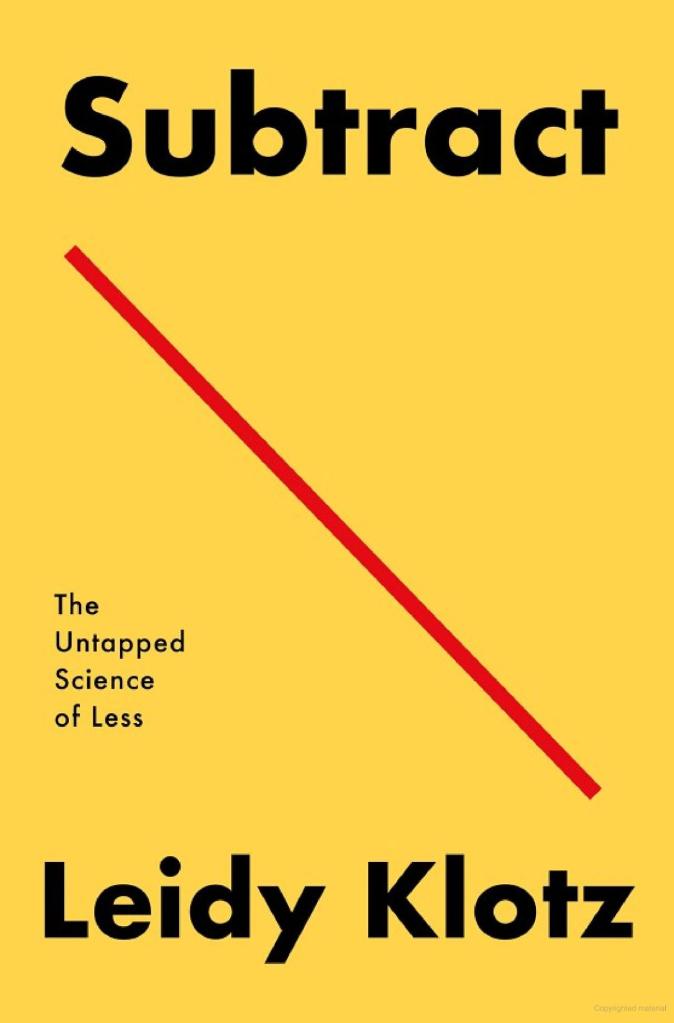
Teachers have been telling us they have too much on their plates for years. Things haven’t slowed down. Recently I finished the book Subtract, by Leidy Klotz. What follows is not a book review, but a summary of some thoughts I had while I was reading the book. These are my thoughts as the concepts explored in the book relate to education.
This is a reflection, about a month after finishing the book. I listened to the book on audio and have my haphazard phone notes to guide me.
Klotz’s Big Ideas
In the end (spoiler alert), Klotz leaves us with 4 guiding principles.
4 steps that direct our expertise:
- Subtract before improving
- Make subtracting first
- Persist to noticeable less
- Reuse your subtraction
The concept of the book is driven forward by the author’s experience of a “light bulb” moment when he was building with Legos with his son. To make a lego bridge level, Klotz’s natural inclination was to add lego pieces. He notices his son takes pieces away. Ultimately, with a research partner, they dive into the research of addition vs. subtraction. They find that humans are much more likely to add than to subtract when problem solving. They also investigate many different situations where subtraction yielded profoundly better results.
Humans tend to add to improve. Klotz reminds us of how often our solutions are additive and how seldom they are subtractive in nature.
- Traffic problems? Build more roads.
- Make my piece of writing better? What is missing that I could add?
- Improve an architectural design? What can I add to it?
- How can I make this recipe better? Add seasoning?
Klotz and his research partners, Gabrielle Adams and Ben Converse, set out to prove that humans neglect subtraction as a way to change things. They recreated the lego situation mentioned above. Only 12% of people used subtractive solutions. When asked to change a random loop of musical notes, participants were 3 times more likely to add than subtract. Experiments for improving a piece of writing also yielded a 3 to 1 ratio. When asked to improve a recipe, only 2 out of 90 participants subtracted ingredients!
Sometimes subtractive solutions are outright better. Consider the strider bike. The pedal-less bike makes the practice of balancing on a bike accessible to children in preschool. Once the child has mastered balance and is strong enough to pedal, training wheels aren’t needed. It’s very difficult for our brains to come up with this type of solution! Someone had to get beyond adding to a smaller traditional bike and come up with a simplification of the whole design.
Humans value what we have and are resistant to let it go. Klotz discusses Daniel Kahneman’s work on loss aversion. Kahneman’s studies showed we value what we already have as more valuable than if what we had belonged to someone else. We are naturally resistant to taking away or simplifying.
Whether we add OR subtract, we add tension to the system. At one point, Klotz shares this idea: If you are trying to help your 5 year old transition from ipad games to bath time, what are some solutions? You might decide to offer a punishment if the behavior is poor. Most 5 year olds will be quite reactive to that. Or perhaps you choose a reward. “Get off the iPad on time, you get a cookie.” Of course, now, when the transition is hard, you have a 5 year old who has given up an iPad and not received a cookie. Klotz argues that rather than addition or subtraction, changing our systems is a better solution that doesn’t add tension to the system. That is to say, changes in policies or practices above and beyond the scope of an issue might be better than the tension that comes with adding or subtracting in a small way. For the iPad example, perhaps “no evening iPad” actually removes the tension altogether.
Subtracting now gives us resources to add with later. When we watch subtractive experiments play out, take a longer view. Klotz reminds us of the donut hole or state budget changes that demonstrate the powerful change that can happen when we later reallocate the time, money, or resources we have subtracted.
The busy trap: “A US Army War College report found that Army officers have 256 available days in which to fit 297 days of mandatory activities. Their decision is not whether to cut corners, it’s which corners to cut.”
Now I would encourage you to take a minute, just a minute, and think about which of these you think applies most to our schools and education systems. From a classroom, school district, or even state level, I was making connections the whole time I read the book.

The busy trap. No one thinks we should STOP DOING anything. Keep doing everything you love; also here is some more new stuff. Teachers have all experienced this. You have 300 minutes of curriculum and 180 minutes of class time. You have four resources available and “all are equally important.” This reminds me of the army officer with more days of work than available days. We must, at the least, acknowledge that we are leaving it to teachers to decide which corners to cut. I believe expert teachers are able to be responsive to students and make efficient and helpful decisions. I also think guidance should be given. It’s hard to imagine a world in education where we subtract before we add!
Subtracting now gives us resources to add with later. I wonder…what would happen if we subtracted a teacher requirement now and didn’t add something back in right away? Hear me out, what if we lightened the load and then, say 6 months or 9 months later, we pilot some “addition” ideas. What would happen with the later opportunity to reinvest that time and energy that we freed up? And consider the interim value of the pause. We gave the system and the teacher a margin in which to breathe.
Whether we add or subtract, we add tension to the system. Where are we focusing on carrots and sticks when we really need a systemic change? I wonder if there aren’t situations in our schools where the best solution might be to “put the iPad away.” How can we change the system to change the game? If an assignment in my classroom is only possible with lots of carrots/sticks, perhaps I need to restructure that assignment, the classroom environment, or even the time of day it is worked on. At a building level, maybe we have overcomplicated some of our carrots/sticks situations. Are we focusing on what truly matters? Are we missing something simple in our system that could fundamentally change the game?
Humans value what we have and are resistant to let it go. How do we create a culture that says “ok” to letting go of things when “We’ve always done this way.” I feel this one in my bones. Because I would love for others to stop doing things that I deem unnecessary, but I can be a bit dogmatic about some of my favorite practices. What if we stopped having birthday celebrations in the classroom? What if we stopped taking whole class bathroom breaks for 3 – 5 grades? What if we eliminated a meeting or block of instruction? What if the assembly was half as long or had no introductions? What if we eliminated 1 “warm up” activity a week? What if that PD was shorter?
Sometimes subtractive solutions are outright better Where is the low hanging fruit in this thought experiment. What is one things I could “stop doing” right now? What about my department or grade level? Systematically, is there something obvious that would have benefits for the students if it simply didn’t exist?
Humans tend to add to improve. What about in schools? Schools exemplify this behavior as well. Probably because they are full of humans who care deeply about making a difference in the lives of students. And humans have a tendency to prefer additive solutions.
Thanks for participating in this thought experiment. What would happen if we all considered ways we could subtract? Subtraction is not the right way to solve every problem. But since we fail to consider it much at all, it’s a great place to start when we desire change.
References to the book above were from the following source:
Klotz, L., & Petkoff, R. (2021). Subtract: The untapped science of less. Macmillan Audio.
 Tim's Teaching Thoughts
Leave a comment